§Our method
AI patent search with human verification, documented down to the query string
Models widen the net. Analysts read every reference, a second analyst reviews every report, and you receive the audit trail: databases, CPC classes, query strings, date cut-offs, AI tools, and notes.
§ 01Why hybrid
Recall from the machine, judgment from a person
Our method is AI patent search with human verification at every step that decides what you read. Two numbers describe any search. Recall is the share of the relevant documents that the search found. Precision is the share of the documents found that are actually relevant. Keyword searching tends to be precise and narrow: it finds what you already know to ask for. Semantic AI search tends to raise recall: it finds documents that describe the same idea in words you would never have typed. Neither can tell you, on its own, which of 400 candidates discloses the third element of your claim. A person reading carefully can.
So we split the work along that line. Models and classification tools generate candidates. Analysts decide relevance. A second analyst checks the first. Then we hand you the record of every step, so your patent attorney or agent can rerun the search, extend it, or challenge it.
The line matters more each year. In July 2025 the USPTO gave design examiners DesignVision, an AI image search across more than 80 global registers. It has also piloted automated pre-examination searches that sent applicants AI-ranked prior art before an examiner opened the file. If the office’s own models will surface the obvious references, a search worth paying for has to find what models miss: non-patent literature, foreign-language family members, and older documents that name the same mechanism differently.
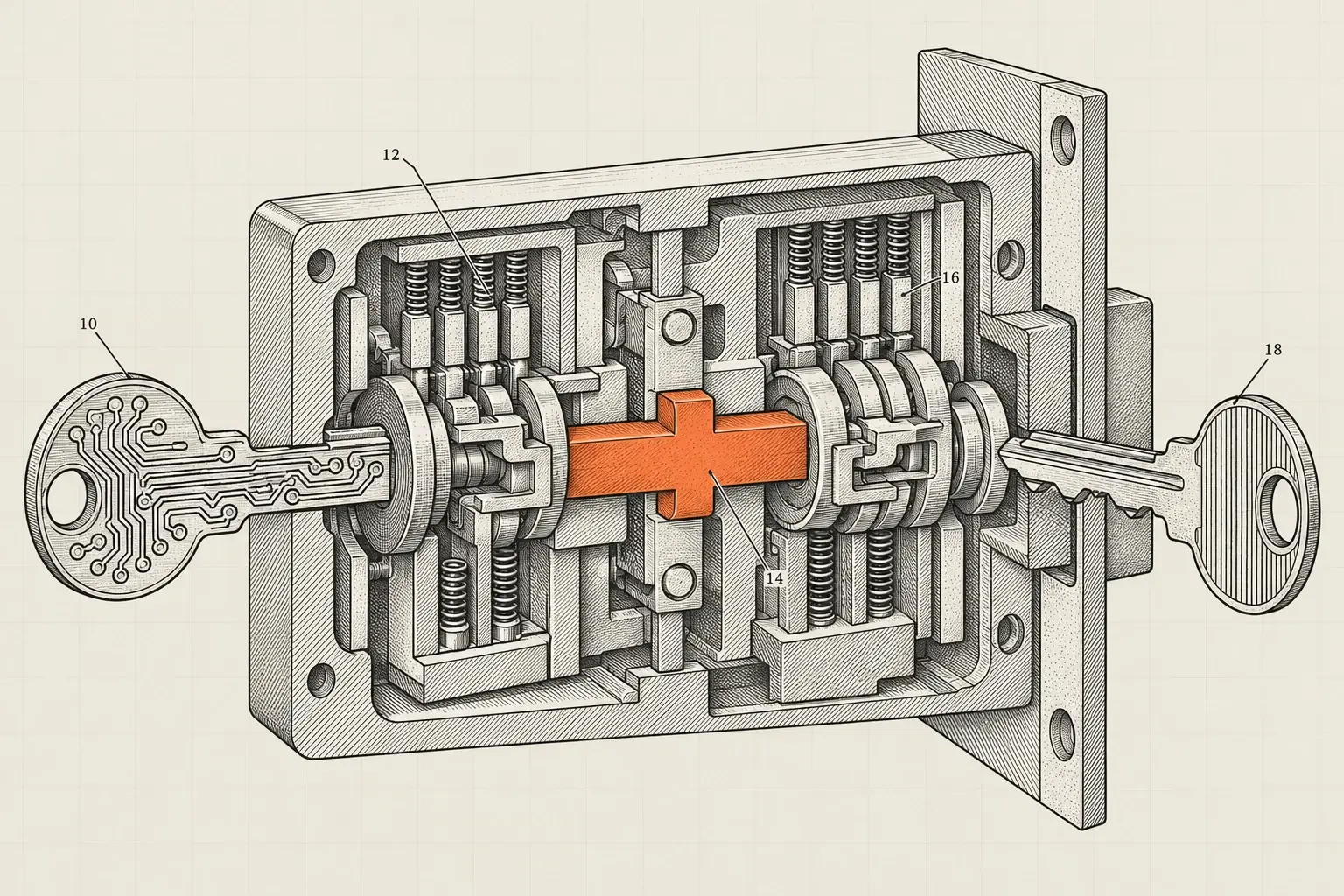
Two keys, one vault: no result leaves without both the model and a person.
§ 02Sequence
The method, step by step
Eight steps, in the same order on every search. The scope sets the depth of each step. The sequence never changes.
- 01
Scoping
A free 20–30-minute call to pin down the decision the search supports, the features or claim elements in play, the jurisdictions, the date cut-off, and who receives the report: you, or your patent attorney or agent. All of it goes into the fixed-fee written quote.
- 02
Query design
The lead analyst breaks the invention into elements, builds term lists and Boolean strings, and identifies the relevant groups in the Cooperative Patent Classification. This human hypothesis comes first, so the AI is tested against it rather than trusted in its place.
- 03
AI-assisted semantic recall
We describe the invention in natural language and run semantic searches that match documents by meaning rather than by shared words. Every tool, query, and run date is logged. The output is a list of candidates, never a list of results.
- 04
Classification and citation expansion
Strong candidates point to more. We follow their CPC groups, their backward and forward citations, and their family members in other countries. That is where foreign-language and early-filed versions of the same disclosure tend to surface.
- 05
Non-patent literature
Journals, conference papers, theses, standards documents, product manuals, and archived web pages. Much of the earliest public description of a technology never appears in a patent, so we search these sources by scope and record the date each item became public.
- 06
Analyst reading
Every candidate that survives screening is read by a person: claims, description, and figures. Relevant references are mapped element by element in a technical claim-element chart, with notes on why each was kept or set aside.
- 07
Second-analyst review
A different analyst checks the queries against the scope, rereads the closest references, challenges the mapping, and signs off. The second reader is never the person who ran the search.
- 08
Audit trail delivery
You receive a PDF report, a spreadsheet of references with links, and the audit trail. Where the scope calls for it, the results also live in a Hoard workspace you can come back to.
§ 03Deliverables
What the audit trail contains
The record we hand over is the record we worked from. Nothing is summarized away.
Databases searched
Each source by name and coverage. Public sources often include USPTO Patent Public Search, Espacenet, WIPO PATENTSCOPE, and Google Patents, alongside the commercial and non-patent sources the scope requires.
Classifications
Every CPC group searched, with a note on why it was included and which neighboring groups were considered and left out.
Query strings
The exact Boolean and semantic queries, in the order they ran, so they can be pasted back into the same database and repeated.
Date cut-offs
The dates that bound the search. Most applications publish about 18 months after their earliest filing date, so the newest filings cannot be seen by anyone, and the cut-off makes that gap explicit.
AI tools used
The name of every AI tool that touched the search, what it was asked, and when it ran.
Analyst notes
Why each close reference was kept, why near misses were set aside, and what the second reader changed.
§ 04Quality
Quality metrics we track internally
We measure our own work continuously. We don’t publish the numbers, because small samples make tidy percentages misleading and a number without its method is marketing. On a scoping call, we’ll explain how each one is measured.
Second-reader change rate
How often the review adds a reference, removes one, or changes a mapping. Too low suggests reviews are rubber stamps. Too high says the first pass needs work.
Late finds
References that surface after delivery, in a later search or an office action a client chooses to share, that our search should have caught. Each one is traced back to the step that missed it.
Where the closest art came from
Whether each top reference came from semantic recall, classification, citations, or non-patent literature. It shows where each technique earns its place, and where we lean too hard on one.
Non-patent literature share
How often the closest art sits outside the patent record, by technology. It keeps us honest about how much NPL depth to put into a quote.
Delivery against the quoted date
Whether reports and drawing proofs arrive on the turnaround we quoted. A missed date is reviewed like a missed reference.
Causes of drawing revisions
Why drawings come back, sorted into our error, a client change, or a format question, so the next set needs fewer rounds.
§ 05AI data policy
What AI touches, and what it never keeps
AI tools touch your search, so you should know exactly how your material is handled.
- Never used for training. Client materials are never used to train AI models. We use AI tools only on terms that keep your inputs out of model training.
- NDA first. An NDA is available before any technical disclosure. Until it is signed, we ask only for what you would say in public.
- US-based handling. Client files are kept in US-based systems and encrypted in transit and at rest.
- Deletion on request. We delete client files on request within 30 days of project close.
- Disclosed in writing. Every audit trail names the AI tools used on your search, so nothing about the method is hidden from you or your counsel.
For how we handle information collected through this website, see our privacy policy.
§ 06Compare
Three ways to search, side by side
Free databases are excellent, and we use them every day. The difference between these options is rarely the database. It is the reading and the record.
| Item | Free do-it-yourself search | AI-only search tool | Meta Dragons hybrid |
|---|---|---|---|
| How references are found | Your own keywords, in one or two free databases | Semantic similarity across the tool’s collection | Semantic recall, then classification and citation expansion, then non-patent literature |
| Who reads the results | You, if time allows | No one, unless you do | An analyst reads every reference, and a second analyst reviews the report |
| Non-patent literature | Rarely searched | Depends on the tool’s coverage | Searched to scope: journals, theses, standards, manuals, and archived pages |
| Mapping to your features | Informal notes | Similarity scores | Technical claim-element mapping with analyst notes |
| Audit trail | Whatever you remembered to save | Often the query and a ranked list | Databases, CPC groups, query strings, cut-offs, AI tools, and notes |
| Confidentiality | Your queries run on public websites | Depends on the vendor’s terms | NDA, US-based systems, and no training on client materials |
| Best for | A first orientation before you spend money | Fast triage of large document sets | Decisions you will put money or a filing behind |
Want to try the first column yourself? Our guide to a free patent search walks through it.
§ 07Questions
Questions about the method
Something else on your mind? Call (505) 357-5188 or write to info@metadragons.com.
Which AI tools do you use?
It depends on the technology and the scope, and the tools change often. Rather than list them here and let the list go stale, we name every tool used on your search in its audit trail, with what it was asked and when it ran.
Does AI replace the analyst?
No. AI widens the set of candidates. It does not decide relevance, map a reference to your claim elements, or sign off on a report. A person does all three, and a second person checks.
Can my patent attorney rerun your search?
Yes. That is what the audit trail is for. Query strings, CPC groups, databases, and date cut-offs are recorded so your attorney or agent can repeat the search, extend it, or challenge it.
Could an examiner still find something you didn’t?
Yes. No search is exhaustive, and most applications stay unpublished for about 18 months after filing, so recent filings are invisible to every searcher. We record exactly what we covered so the gaps are visible rather than hidden.
Does your report tell me whether to file?
No. It tells you what the record contains and how each reference maps technically to your invention. Whether to file, and what the references mean legally, are questions for your patent attorney or agent. Our scope page explains where that line sits.
Keep reading
Where the method is used
§Next step
See the method applied to your question
Book a free scoping call. We’ll tell you which steps your search needs, how deep each should go, and quote it at a fixed fee within one business day.