§Patent Analytics & Intelligence
Patent landscape analysis that shows where the open ground might be
Who is filing what, where, and how fast, mapped from cleaned data and read by analysts. You get rankings, trends, clusters, and whitespace hypotheses, plus a Hoard Atlas workspace to explore them.
- Typical turnaround
- 3–6 weeks
- Best for
- Strategy and R&D leaders, founders preparing investor decks, and SBIR/STTR and other grant applicants
- You receive
- A landscape report, the underlying data, whitespace hypotheses, and a Hoard Atlas workspace
- Delivered to
- You and your team, with sources stated so reviewers can check them
§ 01Deliverables
What you receive
Charts you can defend line by line, because the data behind them was cleaned before it was counted.
Assignee rankings
Who holds what, with names reconciled across subsidiaries, acquisitions, and spelling variants, and families counted once rather than once per country.
Filing trends
Filings over time by technology, company, and country, with the publication lag marked so the most recent years aren't misread as a slowdown.
Technology clusters
Families grouped by what they actually do, named in plain language, with representative documents for each cluster.
Geographic coverage
Where protection is sought, and where it is not, by company and by cluster.
Whitespace hypotheses
Areas where the record looks thin relative to commercial interest, each stated as a hypothesis with the evidence for it, the evidence against it, and a way to test it.
A Hoard Atlas workspace
An interactive version of the landscape, with assignee skylines and classification overlap, set up by an analyst. See Hoard Atlas.
§ 02Overview
When teams use it
R&D and product strategy
Before committing a roadmap, see who is already working in the space, how fast they are filing, and where.
Investor decks
Investors ask about the competitive patent picture. Answer with a chart whose sources and date cut-offs are written on it.
Grant proposals
SBIR/STTR commercialization sections are stronger with evidence than with assertion. See support for startups and grant applicants.
Licensing and tech transfer
Companies filing near an invention are a natural first list for outreach. A landscape often feeds Licensee Identification.
§ 03Process
How it works
- 01
Frame the decision
A free 20–30-minute scoping call on the decision the landscape must support. A fixed-fee written quote follows within one business day, and an NDA is available before you share anything.
- 02
Draw the boundary
We define the technology in classifications, concepts, and exclusions, test the definition on sample documents, and share it with you before the full pull.
- 03
Clean the data
Families grouped, assignee names reconciled, legal status checked. AI-assisted where it speeds the work, analyst-verified throughout.
- 04
Cluster and read
AI-assisted clustering, then analysts read representative documents and name each cluster. A second analyst reviews the report.
- 05
Deliver
Report, data, and Atlas workspace in 3–6 weeks, with the audit trail of databases, classes, queries, and cut-offs.
§ 04Context
A gap on the map is a question, not an answer
Every patent landscape analysis eventually meets the same question: where is the open ground? It is the right question, often asked carelessly. A thin patch on a patent map can mean three different things. The area may be open. It may be commercially unattractive, which is why nobody filed. Or it may be busy with work published outside the patent system, in papers, standards, and products, so the gap exists only on the patent map.
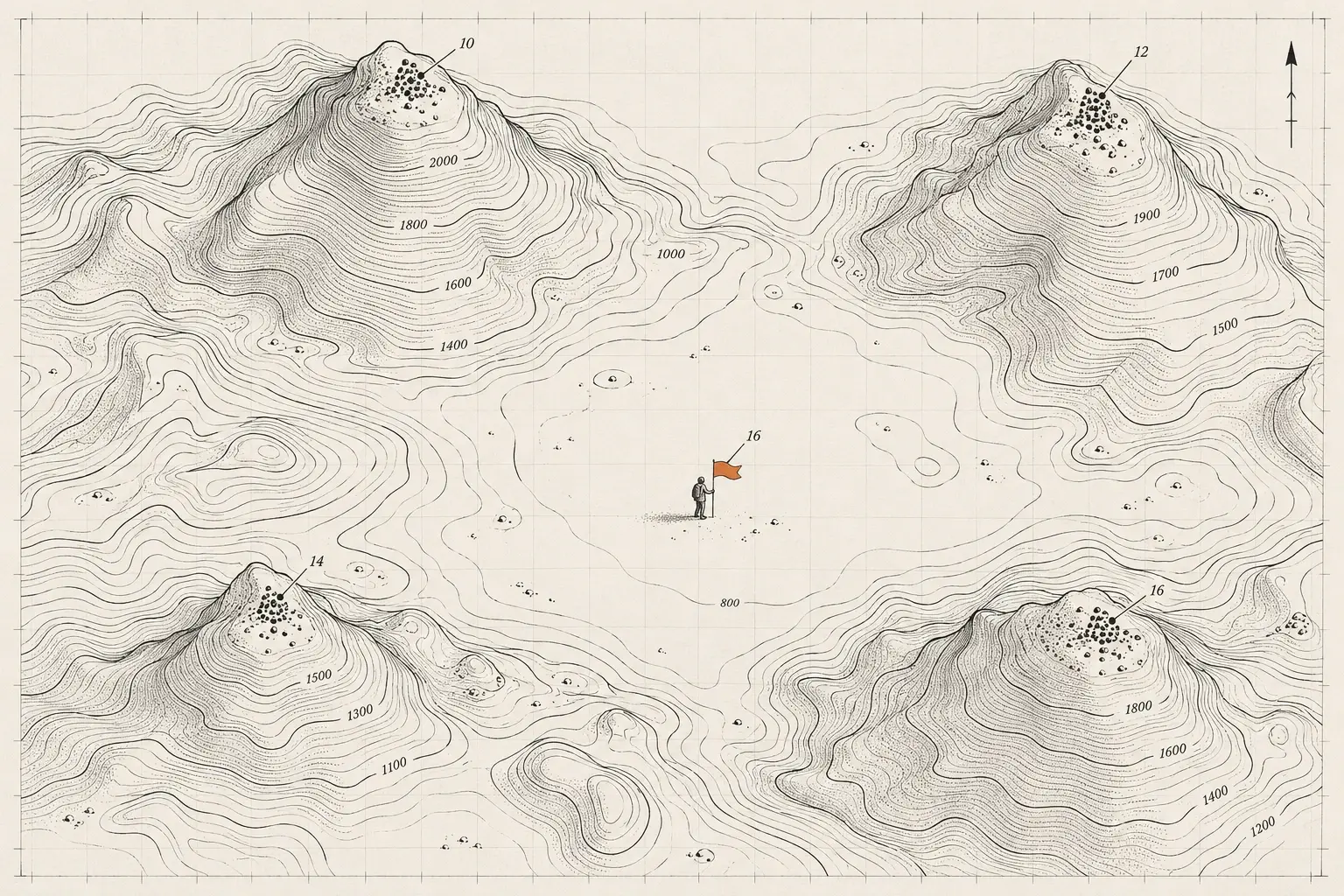
That is why we frame whitespace as hypotheses, never as findings. Each comes with the evidence that suggests it, the evidence against it, and the cheapest way to test it, often a focused Patentability Search on one concept. Whitespace is not empty land. It is a valley no one has mapped yet, and a careful team walks it before building there.
One more trap is built into the data itself. Applications are generally published about 18 months after the earliest filing date (35 U.S.C. 122(b)), so the most recent year and a half of any landscape is always thin. A trend line that drops at the end usually shows the publication lag, not a retreat. We mark that zone on every trend chart.
§ 05 — Boundaries
What this is not
- Not legal advice about any patent's scope, validity, or enforceability.
- Not a clearance search. A landscape shows the shape of a field; it does not check your product against in-force claims. That is a Product Clearance Search.
- Not investment advice. Landscapes inform business planning; they don't value companies or recommend investments.
- Not a promise that whitespace is available. Hypotheses need testing before anyone builds on them.
Metadragons LLC is not a law firm. Landscapes describe the public patent record for business planning.
§ 06Questions
Questions buyers ask
Something else on your mind? Call (505) 357-5188 or write to info@metadragons.com.
What do you need from us?
The decision the landscape must support, the technology in your own words, any competitors or terms you already know, and the countries you care about. The scoping call usually covers it.
How long does it take?
3–6 weeks, depending mostly on the size of the field and how much reading the clusters need.
How is this different from the charts in a free patent database?
Free tools will chart raw results instantly. The work is in what comes before the chart: a tested boundary, reconciled assignee names, grouped families, and analysts reading the documents. Without that, the tallest bar on the chart is often a spelling variant.
Can we use the charts in an investor deck or grant proposal?
Yes. Sources and date cut-offs are stated so reviewers can check them. Keep in mind the charts describe the patent record; they are not investment advice.
Do we keep access to the Atlas workspace?
Hoard Atlas is included with landscape engagements, by invitation. Ongoing access or periodic refreshes can be added as a standalone Hoard subscription, quoted per scope.
Is our interest in the field kept confidential?
Yes. The question you ask can reveal your strategy, so we treat it like a technical disclosure: NDA available up front, US-based handling, encryption in transit and at rest, no use in training AI models, and deletion on request within 30 days of project close.
Keep reading
Where to go next
§Next step
Start with the decision, not the chart
Tell us the decision you're facing. After a free scoping call, you'll have a fixed-fee written quote within one business day.