§Valuation & Commercial Assessment
Patent due diligence facts, in one standard pack
IP Due-Diligence Data Packs give investors, lenders, litigation funders, and acquirers the public record on a patent or portfolio: family, assignments, status, citations, dockets, and comparables, sourced and laid out the same way every time.
- Typical turnaround
- 5–10 business days
- Best for
- Venture investors, lenders, litigation funders, and acquirers
- You receive
- A standardized PDF pack, a linked spreadsheet, and the source trail
- Delivered to
- You, your deal team, and your counsel
§ 01Deliverables
What you receive
Six sections, in the same order for every asset, so a pack on one deal can be read side by side with a pack on the next.
Family map
Every family member we can find across patent offices, with priority claims, continuations, and divisionals, and the public status of each. Gaps in coverage are visible at a glance.
Recorded assignment history
Assignments from the USPTO’s public Patent Assignment Search, laid out as a timeline. Breaks, name mismatches, and missing inventor assignments are flagged as findings for counsel.
Maintenance and status
Fee payment history, the next maintenance-fee window, any grace-period status, and the term-related entries the public record shows, such as terminal disclaimers and term adjustments.
Citation metrics
Forward citations, the assignees doing the citing, examiner versus applicant citations, and how the asset compares with peers in the same classification.
Related proceedings
Public docket facts only: federal court cases from PACER and Patent Trial and Appeal Board proceedings, with case numbers, parties, dates, and recorded outcomes.
Comparables
Similar assets and any public transaction or licensing references we can source, each with its citation, plus a note on how close the comparison really is.
§ 02Overview
When teams use it
Venture and growth investors
Before a term sheet, confirm that the patents in the deck exist, are in force, and are recorded to the company. See how we support investors and lenders.
12Lenders reviewing IP collateral
One consistent pack per borrower, so collateral reviews compare like with like. Add a commercial valuation when you need a range as well as the record.
Litigation funders
Family status, citation context, and docket history gathered before you pay counsel for the deeper merits review.
Acquirers
First-pass facts on a target portfolio before counsel’s title and validity work, or on each finalist from a buy-side search.
§ 03Process
How it works
- 01
Scope
Send a patent list or an assignee name, the decision the pack supports, and your deadline. After a free scoping call, you get a fixed-fee written quote within one business day.
- 02
Pull and reconcile
We gather public patent office records, assignment data, and dockets, then reconcile family members, name variants, and former company names.
- 03
Verify
An analyst checks every record against its source, and a second analyst reviews the pack. Anomalies are flagged, never smoothed over.
- 04
Deliver
You receive the PDF pack, a spreadsheet with links to every source, and the audit trail. Where it helps, the portfolio loads into a Hoard Ledger workspace.
- 05
Support counsel
We answer factual follow-up questions from your counsel. They draw the legal conclusions; the pack makes their review faster.
§ 04Insight
The record is not the title
Most patent due diligence fails in a dull way. The deck lists 12 patents, and nobody checks that all 12 are in force, recorded to the company, and part of the families the founders describe. Those are factual questions with public answers, and they belong at the start of a deal, not the week before closing.
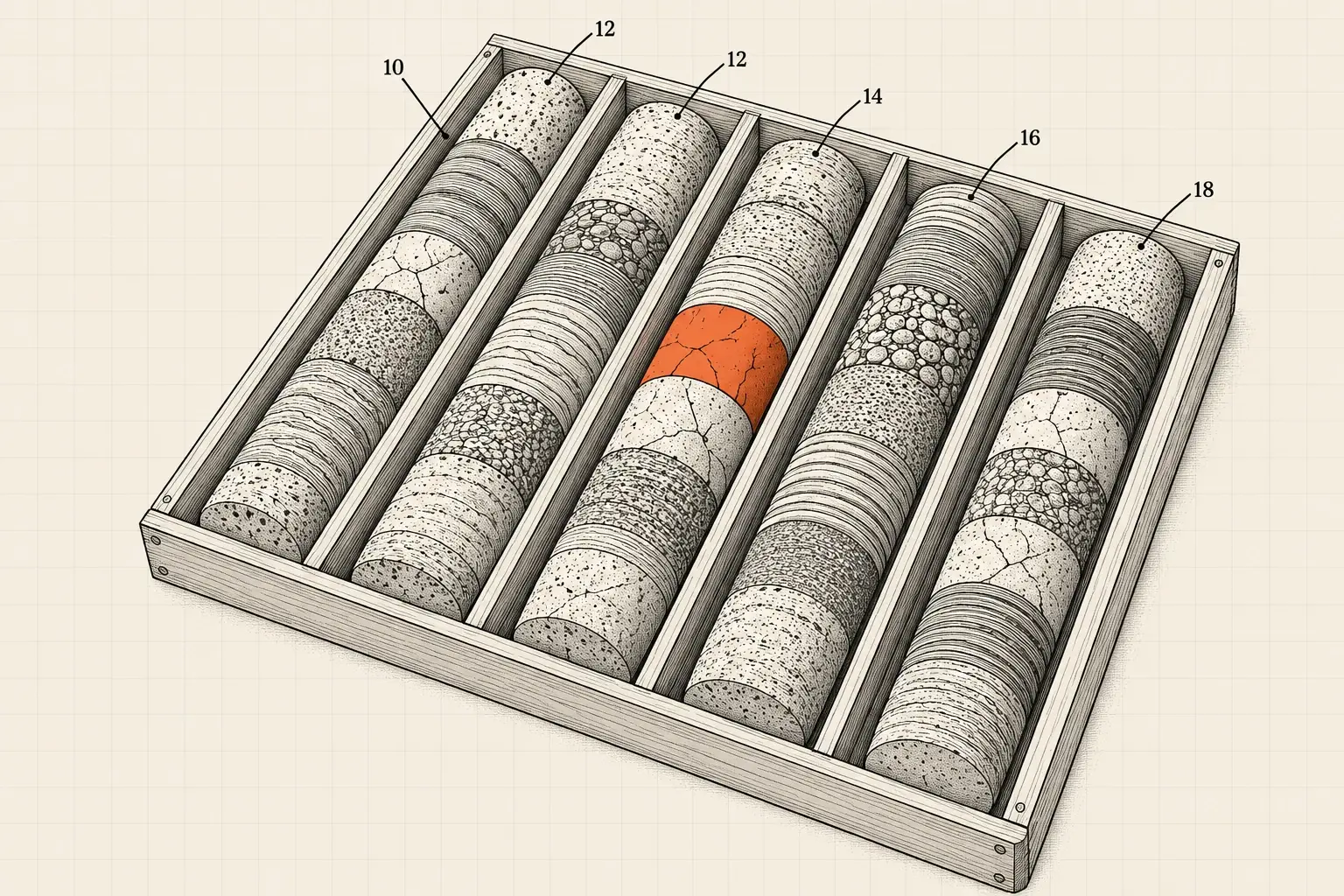
A data pack works like a core sample. It shows the layers as they are, gaps included. A missing assignment from an inventor, a fee in its grace period, or a continuation still recorded under a founder’s previous company shows up in the layers.
One rule shapes how we write every pack. The USPTO records assignment documents, but under 37 CFR 3.54, recording “is not a determination by the Office of the validity of the document or the effect that document has on the title.” So we report what is recorded and flag what looks wrong. Whether the company owns the patent is a conclusion for counsel. Our job is to make sure counsel starts with every relevant fact already gathered, sourced, and in order.
We report what is recorded and flag what looks wrong. Ownership is counsel’s call.
§ 05 — Boundaries
What this is not
- No title opinion. We report recorded assignments; counsel concludes who owns what.
- No opinions on validity or enforceability, and no view on whether any product practices the claims.
- No analysis of litigation merits. Docket facts only.
- No investment, lending, or credit recommendation.
- Not a substitute for counsel’s diligence. It is the factual groundwork that makes that diligence faster.
§ 06Questions
Questions about data packs
Something else on your mind? Call (505) 357-5188 or write to info@metadragons.com.
What is in a standard pack?
Six sections: family map, recorded assignment history, maintenance and status, citation metrics, related proceedings, and comparables. Each comes with a linked source, so anyone on your team can check our work.
How is this different from legal due diligence?
Counsel’s review produces opinions on title, validity, and risk. Our pack produces the facts those opinions rest on. Many deal teams order the pack first, so counsel’s time goes to judgment rather than record-gathering.
Do you cover foreign family members?
Yes, where public data exists. The family map lists every member we can find, with its status as public sources report it. Foreign status data can lag, and the pack says so when it matters.
Can we share the pack with a lender, co-investor, or the other side?
Yes. It is your deliverable, and it contains only sourced public facts and our analyst notes. Anything you share with us remains confidential under our NDA.
Can you also value the patents?
Yes, as a separate service. Commercial Patent Valuation builds a stated range on top of the pack, with every assumption written down.
How fast can you turn a pack around?
Typically 5–10 business days, depending on the number of assets and families. Your quote states the timing before work begins, and nothing is billed beyond it without your written approval.
Keep reading
Where to go next
§Next step
Start the deal with the facts
Send the patent list or the assignee name. After a free scoping call, you’ll have a fixed-fee written quote within one business day, and a pack in 5–10 business days.