§Patent Search & Research
See what the examiner's AI could find, before you file
Our patentability search services deliver a full prior-art report: patent and non-patent literature from around the world, technical claim-element mapping, and an audit trail your practitioner can check line by line.
- Typical turnaround
- 5–7 business days
- Best for
- Inventors, startups, and practitioners preparing to draft or file an application
- You receive
- A search report, technical claim-element mapping, a reference spreadsheet, and the audit trail
- Delivered to
- You, or your patent attorney or agent
§ 01Deliverables
What you receive
Everything a practitioner needs to check our work, and nothing they need to redo.
Search report
The closest references, ranked and summarized, with the passages and figures that matter quoted or cited. Patents and published applications from around the world, plus non-patent literature.
Technical claim-element mapping
Your invention broken into its technical elements, and a table showing where each element appears in each close reference. Facts laid out for your attorney or agent to weigh.
Non-patent literature
Journal articles, conference papers, theses, product documentation, and standards documents where relevant. These sources are cited in examination too, and keyword tools often miss them.
Reference spreadsheet
Every cited document with links, publication dates, assignees, family members, and our relevance notes, ready to sort, share, or import.
Audit trail
The databases, CPC classes, query strings, date cut-offs, AI tools used, and analyst notes. Your practitioner sees exactly what was searched, and what was not.
§ 02Overview
When teams use it
Before a nonprovisional or international filing
Claims written with the closest art in view are easier to defend than claims amended around it later. The search gives your practitioner the map before drafting starts.
Before converting a provisional
The conversion deadline is a natural checkpoint. Learn what is out there while there is still time to adjust the plan.
For practitioners with a full docket
Outsource the search and keep the judgment. Reports are built to be checked, and we deliver straight to you. More on how we support practitioners.
For startups telling a credible story
Investors and grant reviewers ask about prior art. Knowing the closest references makes your answer specific. See support for startups and grant applicants.
§ 03Process
How it works
- 01
Scope and quote
A free 20–30-minute scoping call, then a fixed-fee written quote within one business day. We sign an NDA before any technical disclosure.
- 02
Break down the invention
We split the invention into its technical elements and confirm them with you or your practitioner before the search begins.
- 03
Search wide
AI-assisted recall through semantic search plus classification and citation expansion, across patent and non-patent sources worldwide.
- 04
Read and map
An analyst reads every candidate reference and maps the closest ones element by element. A second analyst reviews the full report.
- 05
Deliver
The report, spreadsheet, and audit trail arrive in 5–7 business days, to you or directly to your practitioner. Rush timing is available when scope allows and is quoted separately.
§ 04Context
The examiner searches with AI now. Your search has to go further.
Good patentability search services have a new job: anticipating what the examiner's own tools will surface, and then finding what those tools miss. The USPTO has moved AI to the front of examination. An October 24, 2025 memo made the PE2E Similarity Search tool mandatory in the examination of utility and plant applications. The tool reads the specification and claims and returns similar patent documents from domestic and foreign collections. In October 2025 the Office also launched the Artificial Intelligence Search Automated Pilot Program (ASAP!), which sent participating applicants up to 10 AI-ranked references before examination began. That pilot has stopped taking new petitions, but the direction is plain.
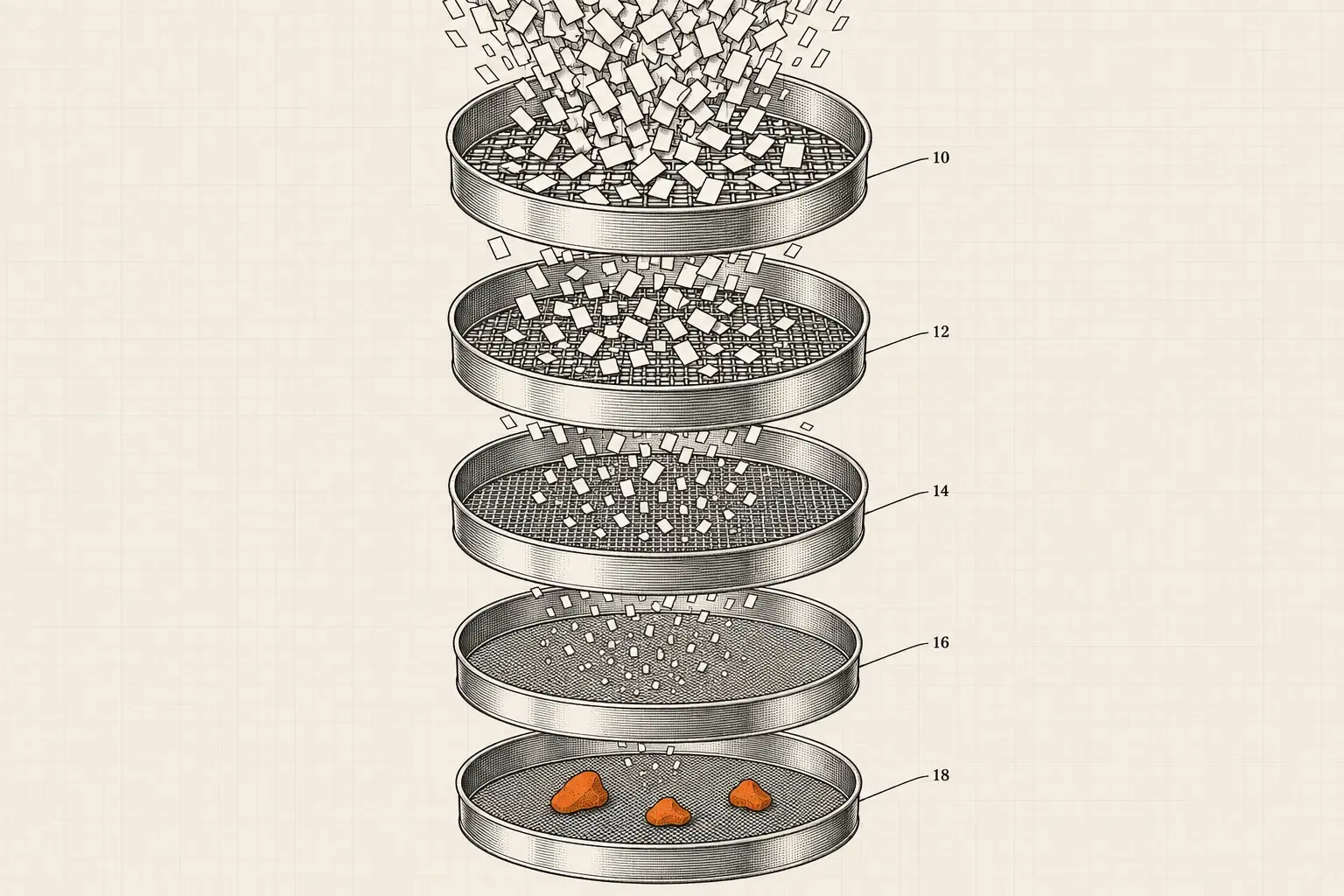
This changes where a search earns its fee. Patents with similar wording are exactly what an AI similarity tool finds first. If your search stops there, you learn little the examiner won't tell you anyway. The value moves to what similarity scores miss: non-patent literature, foreign-language documents, references that describe the same mechanism in different words, and the judgment to say which handful of hundreds of candidates matter. Thousands in, a handful out: what survives every mesh is what your practitioner needs to see.
We use AI for recall too. Then people read every reference.
§ 05 — Boundaries
What this is not
- Not a legal opinion on patentability. Conclusions belong to your registered patent attorney or agent.
- Not drafting, filing, or prosecution. We don't write claims or respond to office actions.
- Not a clearance search. Patentability asks what came before your invention. Clearance asks whose in-force claims your product may meet; that is a Product Clearance Search.
- Not a promise of completeness. No search can show that nothing else exists. The audit trail shows exactly what we covered.
Metadragons LLC is not a law firm. Our reports are technical research for review by you and your patent attorney or agent.
§ 06Questions
Questions buyers ask
Something else on your mind? Call (505) 357-5188 or write to info@metadragons.com.
What should I send you?
A written description, drawings or sketches, and any draft claims or provisional application. Notes from your practitioner on what matters most are welcome. We sign an NDA before you share technical details.
How long does it take?
Typically 5–7 business days from the signed quote and complete materials. Rush timing is available when scope allows and is quoted separately.
How is this different from a free search on Google Patents or Patent Public Search?
Google Patents and the USPTO's Patent Public Search are excellent free tools. A professional search adds systematic classification and citation expansion, non-patent literature, global coverage, an analyst reading every candidate, a second reviewer, and a record of what was searched. The record matters as much as the results.
Can you send the report straight to my attorney?
Yes. The claim-element mapping and audit trail are written for that reader. If you don't have a practitioner, we can share a list of independent practitioners to contact. We receive no referral fees.
Is my invention kept confidential?
Yes. NDA before any technical disclosure, US-based systems, encryption in transit and at rest, and no use of client materials to train AI models. On request, files are deleted within 30 days of project close.
What if the search finds a very close reference?
Then you learn it before paying for drafting, which is the point. Your practitioner may see a way to narrow or reframe the claims, or you may redirect the budget. The decision is yours and your counsel's, made with the evidence in hand.
Keep reading
Where to go next
§Next step
Know the record before you file
Book a free scoping call. You'll have a fixed-fee written quote within one business day, and nothing is billed beyond it without your written approval.