§About Meta Dragons
A patent research company that shows its work
We are a non-legal firm in Albuquerque that searches, maps, illustrates, values, and introduces patents for clients across the US. We publish our method, state our scope, and say no when the evidence says no.
§ 01Mission
Make the patent record legible to the people who must act on it
Meta Dragons is a patent research company built on one belief: decisions about patents are business decisions, and they deserve the same quality of evidence as any other. Should you file? Should you keep paying fees on this family? Who might license it, and what is it worth to them? Each question has a factual layer that someone has to dig out of the record before anyone can make a judgment. That layer is our work.
The name carries the idea. A patent portfolio is a hoard, and the job of whoever guards a hoard is to know three things: what is in it, what surrounds it, and what it is worth. Most owners know only the first. They know their own patents, but not the neighbors filing around them or the market that might pay for them. Meta stands for the layer above the documents: the data, patterns, and connections you only see when thousands of filings are read together.
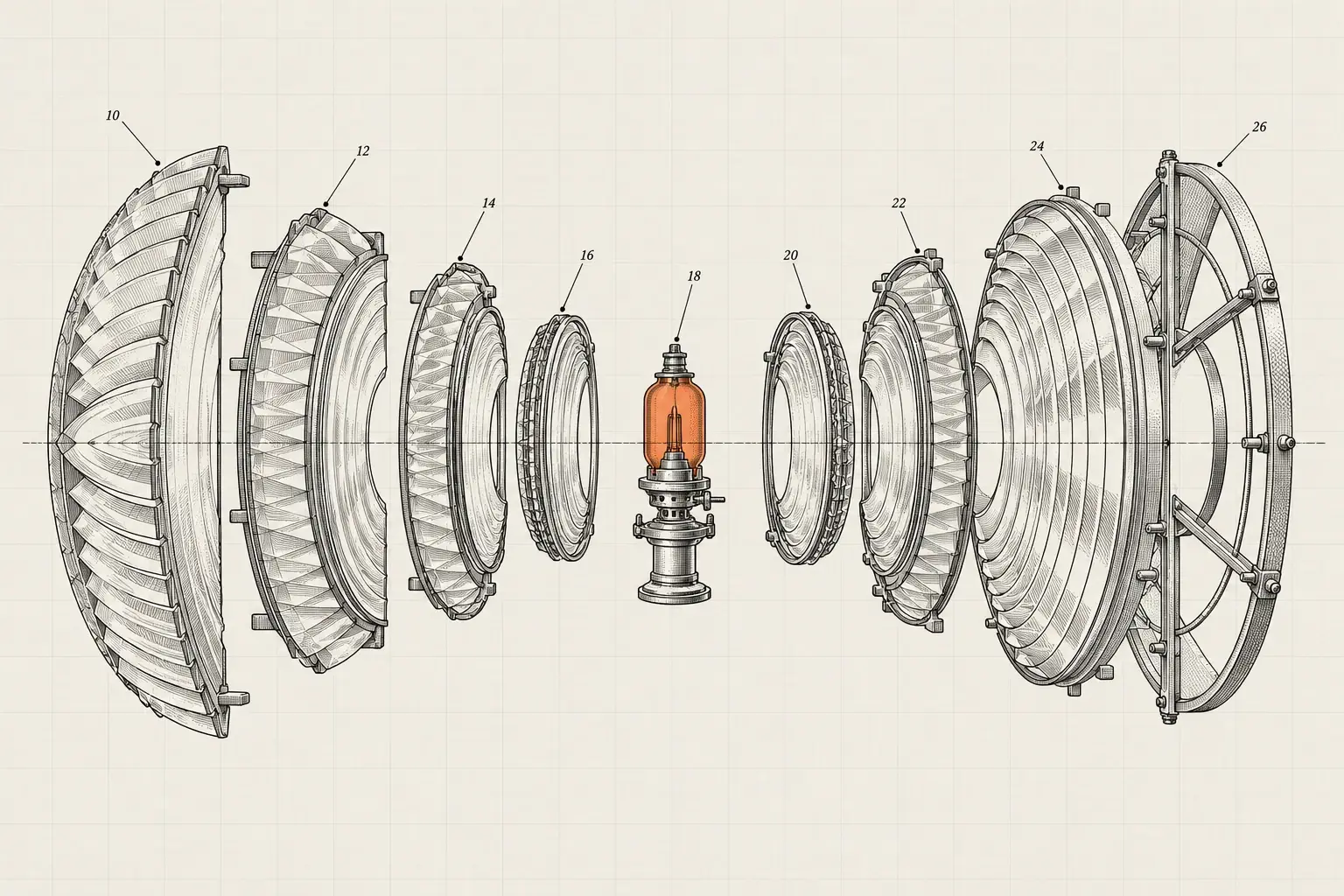
We do that reading with AI-assisted recall and human verification, and then we show you how we did it. Every search ships with its audit trail. Every valuation states its assumptions. Every introduction is documented. In our experience, clarity is engineered from many thin rings of evidence brought to one focus. It is rarely found by luck.
§ 02Why non-legal
Why a non-legal patent firm exists
Patent work contains two kinds of tasks. One is finding and organizing facts: which references exist, what they disclose, who owns what, which fees fall due, which companies make products in a field. The other is legal judgment: whether a claim can be patented, whether a product is at risk, whether an agreement protects you. The law reserves the second kind for licensed practitioners, and it should.
The first kind is a discipline of its own. It rewards engineers who read slowly, data scientists who distrust their own models, and commercial analysts who know how buyers think. A firm built only for that work can specialize in it, staff it by technology, and price it as research rather than as legal time.
There is a second reason, and it matters most to inventors. We don’t draft, file, or prosecute applications, so we earn nothing more if you decide to file. That makes it easier to tell you when the evidence says stop.
When a legal step is needed, we coordinate with your independent registered patent practitioner. If you don’t have one, we can share a list of independent practitioners to contact. We receive no referral fees. The full boundary is set out on our scope and disclosures page, and attorneys and agents can see how we support their practices.
We earn nothing more if you decide to file. That is why we can tell you when to stop.
§ 03Principles
Six principles we work by
These are the rules we hold ourselves to on every engagement, from a 3-business-day inventor snapshot to a 9-month brokerage campaign.
Show the method
Every search ships with its audit trail: databases, CPC classes, query strings, date cut-offs, AI tools, and analyst notes. If you can’t check our work, we haven’t finished it.
12A person reads everything
AI widens recall. People decide relevance. Every reference is read by an analyst, and a second analyst reviews every report before it leaves.
Say no early
When the references are close or the commercial evidence is thin, we say so in plain words and in writing. An early no is the cheapest useful finding we deliver.
Quote first, bill only the quote
You get a fixed-fee written quote within one business day of a free scoping call. Nothing is billed beyond it without your written approval.
18Stay inside the line
We give no legal opinions and draft no agreements. Conclusions about patentability, validity, and freedom to operate belong to your counsel, and our reports say so.
Your material stays yours
An NDA before any technical disclosure, US-based systems, encryption in transit and at rest, and deletion on request within 30 days of project close. Client materials never train AI models.
§ 04Albuquerque
Why we work from the high desert
We are based in Albuquerque, a high-desert city where engineering is close to a local dialect. New Mexico’s national laboratories and its university research ecosystem mean that patents, licenses, and spinouts are everyday conversation here, not abstractions. It is a good place to learn how inventions actually leave the lab, and what it takes for them to survive outside it.
We claim no partnership with any laboratory, university, or agency, and we have none to claim. We mention the ecosystem because it shapes the work. Lab licensees, university startups, and SBIR applicants need landscapes, commercial assessments, and introductions, and those sit near the center of what we do. See how we help universities and labs and startups and grant applicants.
Our clients are spread across the United States. Our hours, Monday–Friday, 8:00 a.m.–5:00 p.m. Mountain Time, overlap the working day on both coasts, and engagements run by phone, e-mail, and shared workspace. Our office is at 1209 Mountain Road Place NE, Suite C, and every way to reach us is on the contact page.
§ 05 — Boundaries
What we refuse to do
Some lines we hold for legal reasons and some for honesty. Either way, they don’t move.
- Give legal advice, or legal opinions on patentability, infringement, validity, or freedom to operate.
- Draft, file, or prosecute patent applications, or respond to office actions.
- Draft, review, or negotiate agreements for clients, including licenses, assignments, NDAs, and term sheets.
- Promise an issued patent, a sale, licensing revenue, or a return.
- Accept referral fees from patent attorneys or agents.
- Publish testimonials, or present illustrative composites as real clients.
- Use client materials to train AI models.
- Charge for anything that was not quoted.
The complete list, our written disclosures to inventors, and the FTC red flags we design against are on the scope and disclosures page.
Facts first. Opinions belong to the people licensed to give them.
We dig out the record, read it, and hand it over with the method attached. Your attorney or agent takes it from there.
Keep reading
Keep reading
§Next step
Start with what you need to know
Tell us the decision you’re facing. We’ll scope the evidence it needs on a free 20–30-minute call and send a fixed-fee quote within one business day.