§Patent Analytics & Intelligence
Standard essential patents analysis, from declaration to section
We map patents declared to standards bodies against the sections of the standard they relate to, for Wi-Fi 6 and 7, cellular, and video codecs. Technical concordance only; essentiality conclusions stay with counsel.
- Typical turnaround
- 3–5 weeks
- Best for
- SEP licensors weighing pool participation, implementers budgeting for licenses, and buyers in diligence
- You receive
- A declaration map, technical concordance tables, family and status data, and the audit trail
- Delivered to
- You, or your patent attorney or licensing counsel
§ 01Deliverables
What you receive
The declared record, cleaned and checked, with each family read against the standard text.
Declaration map
Patents and applications declared to the relevant standards bodies, grouped into families, with declarant, declaration date, and the standard and version cited.
Technical concordance tables
For each family in scope, claim elements set beside the standard sections that describe similar technical features, with section numbers and version. A technical comparison, not a conclusion.
Family, status, and coverage
Legal status, calculated expiry, and country coverage for each family from public records, so a declared portfolio can be sized realistically.
Declarant profiles
Who declared how much, in which parts of the standard, and when, with current owners reconciled where assignments are recorded.
Audit trail
Declaration sources, standard versions, databases, query strings, date cut-offs, AI tools used, and analyst notes.
§ 02Overview
When teams use it
Licensors weighing a pool
Before joining a pool or running a bilateral program, see how your declared families line up against the standard, and against other declarants. If selling is on the table, see Sell Your Patent.
Implementers budgeting
Shipping a Wi-Fi, cellular, or video product? Size the declared landscape you may be asked to license before the first letter arrives. A patent landscape can add the non-declared context.
Buyers in diligence
A declared SEP portfolio is only as strong as its concordance. Check the mapping before you price it, then pair it with a commercial valuation or Patent Acquisition support.
§ 03Process
How it works
- 01
Fix the standard and version
A free scoping call to pin down the standard, the release or version, and the features in scope. A fixed-fee written quote follows within one business day.
- 02
Collect the declarations
From the standards bodies' public declaration records, then reconciled to patent families and current owners.
- 03
Check status and coverage
Expired, lapsed, and pending families are separated from in-force ones, country by country.
- 04
Map to sections
Analysts trained in electrical and computer engineering read claims against the standard text and record where technical features correspond. A second analyst reviews every table.
- 05
Deliver
Report, concordance tables, data, and audit trail in 3–5 weeks.
§ 04Context
A declaration is a statement, not a finding
Standard essential patents analysis starts from an uncomfortable fact: the public record of who holds SEPs is self-reported. Patent owners declare patents they believe may be essential, and the declarations are published largely as submitted. The ETSI IPR Online Database, for example, states that ETSI makes no representation about the validity or relevance of the declared rights, or about whether they are essential.
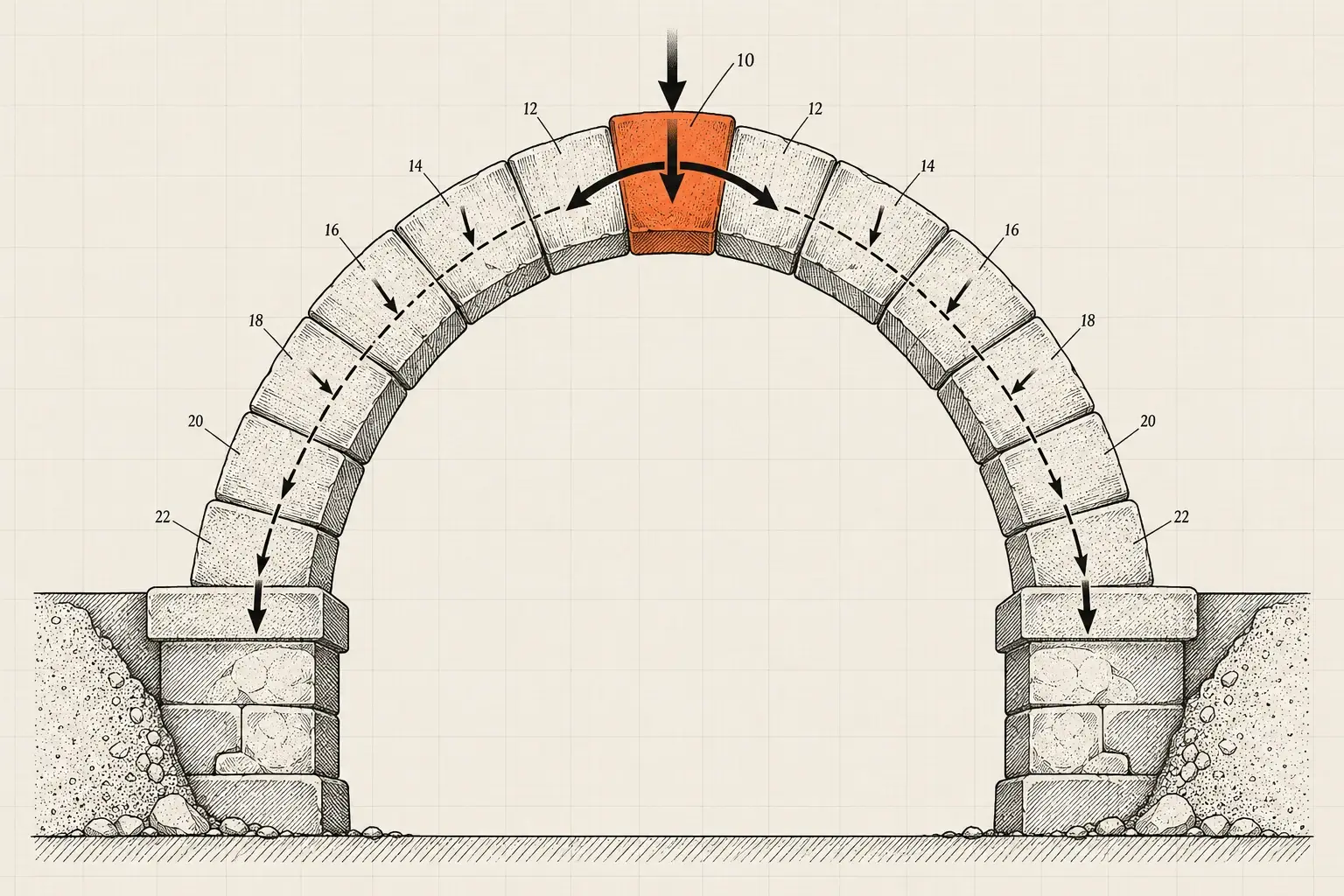
So a declaration count is a starting point, not a measure. A count cannot tell you which families have expired, which have no claims resembling the standard text, or which relate to an optional feature that few products use. A standard is an arch, and some stones carry more of the load than others. Finding which ones is a technical exercise: reading claim elements against specific sections and recording where the features correspond, and where they don't. Deciding whether any patent is essential is a legal question, and it stays with counsel.
The stakes are current. In January 2026 Sisvel launched a Wi-Fi Multimode patent pool covering Wi-Fi 6 and Wi-Fi 7, as the successor to its Wi-Fi 6 pool. Pools like this give licensors and implementers fresh reasons to look closely at what the declarations actually contain.
§ 05 — Boundaries
What this is not
- Not an essentiality opinion. We report technical correspondence; whether a patent is essential is for counsel and, where needed, independent experts.
- Not a FRAND or royalty-rate assessment. We don't set, judge, or benchmark license terms.
- Not licensing or negotiation. Pool and bilateral agreements belong to your counsel.
- Not a full read of every declared family unless the quote says so. We agree on the families and sections in scope up front.
Metadragons LLC is not a law firm. Concordance tables are technical research for review by your counsel.
§ 06Questions
Questions buyers ask
Something else on your mind? Call (505) 357-5188 or write to info@metadragons.com.
Which standards do you cover?
Most often Wi-Fi 6 and Wi-Fi 7 (IEEE 802.11ax and 802.11be), cellular standards, and video codecs such as HEVC (ITU-T H.265) and VVC (ITU-T H.266). Other standards can be scoped on request.
Will you tell us which patents are essential?
No. Essentiality is a legal conclusion, and often a contested one. We give your counsel or experts the technical concordance their judgment can start from.
What do you need from us?
The standard, version, and features in scope; any portfolios or declarants of particular interest; and the decision you face, such as a pool invitation or a license request. Licensors should include a list of their own declared families.
How long does it take?
3–5 weeks, depending mainly on how many families and standard sections are in scope.
How is this different from counting declarations in a free database?
Counting is where we start. Grouping families, checking status, and reading claims against the standard text are what turn a count into information you can plan around.
Is the work confidential?
Yes. Licensing positions are sensitive. NDA available before you share anything, US-based handling, encryption in transit and at rest, and no use of client materials to train AI models. We don't name our clients.
Keep reading
Where to go next
§Next step
Read the declarations before you sign anything
Tell us the standard and the decision you face. After a free scoping call, you'll have a fixed-fee written quote within one business day.