Patent Due Diligence Checklist for Investors: The Data to Pull
Nine data areas to collect before counsel weighs in: what the public record shows, which documents to request, and which questions only a patent attorney can answer.
A patent due diligence checklist for investors should cover nine data areas: the family map, the priority chain, assignment records, maintenance status, inventor agreements, citations, encumbrances as disclosed, litigation and PTAB dockets, and the freedom-to-operate questions you will put to counsel. Most of it comes from free or low-cost public records, and the rest from documents the company must produce. The data shows what exists. Validity, enforceability and infringement are legal conclusions that belong to patent counsel.
Separate the record from the opinion
Diligence slows down when data work and legal work get mixed. Whether the 7.5-year fee was paid is a fact anyone can look up, and it should not consume attorney hours. Whether a claim covers a competitor’s product is a legal judgment, and it should never be inferred from a spreadsheet.
| Question | Data you can gather | Conclusion that belongs to counsel |
|---|---|---|
| Who owns it? | Recorded assignments, inventor agreements | Whether title is clean |
| How long does it last? | Filing dates, term adjustments, terminal disclaimers, fee status | The enforceable term |
| How strong is it? | Prosecution history, citations, PTAB history | Validity and enforceability |
| What does it cover? | Claim text, product facts | Claim scope and infringement |
| Can the company sell its product? | Third-party patents near its features | A freedom-to-operate opinion |
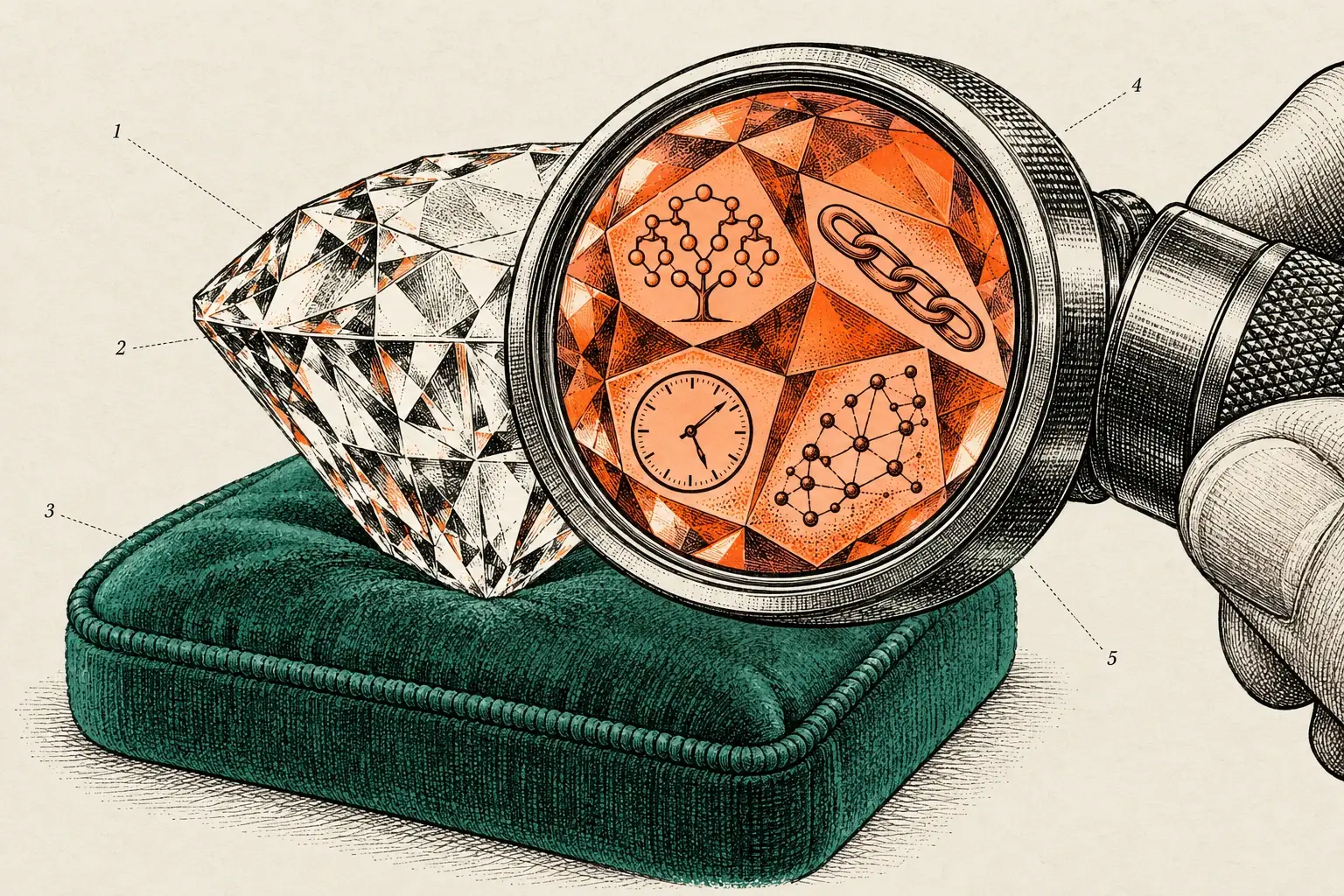
Investors examine facets: family, chain, status, citations. The checklist below follows that order, then adds the documents and dockets that complete the picture.
The checklist
1. Family map
- Every US application and patent in the family: parents, continuations, divisionals and continuations-in-part
- Foreign counterparts and any PCT application
- The status of each member: pending, granted, abandoned or expired
- Which members have issued claims and which are still in prosecution
Global Dossier gives free access to family file histories across the USPTO, EPO, JPO, KIPO and CNIPA. US file wrappers are also in Patent Center, which has required identity verification for all users from September 11, 2025. A pending continuation can matter as much as the granted parent, because its claims are still being written.
2. Priority chain and term
- The earliest effective filing date and every benefit claim in the chain
- Provisional applications, and whether each nonprovisional was filed within the 12 months that 35 U.S.C. § 119(e) allows
- An estimated expiration date for each patent, including any term adjustment or extension
- Terminal disclaimers in each file history
Term generally ends 20 years from the earliest US nonprovisional filing date that the patent refers back to. Foreign and provisional priority claims do not count toward that date (35 U.S.C. § 154). Terminal disclaimers deserve their own flag. Under 37 CFR 1.321(c), a terminal disclaimer filed to overcome double patenting must say the patent is enforceable “only for and during such period” that it stays commonly owned with the patent or application it was tied to. If a deal would split those patents, counsel needs to know.
3. Assignment records
- A chain from every named inventor to the current owner, with no gaps
- Name changes, mergers and conversions recorded in order
- Execution dates compared with recording dates
- Recorded security agreements, and whether each has a recorded release
Search the USPTO’s Patent Assignment Search, which covers assignments recorded from 1980 onward. Recording dates matter. Under 35 U.S.C. § 261, an assignment is void against a later purchaser or mortgagee who paid value without notice, unless it was recorded at the USPTO within three months of its date or before that later purchase. Whether a gap is a real problem is for counsel to judge. Your job is to find it.
4. Maintenance status
- Payment history for every US patent
- The next fee window and its amount
- The entity status (large, small or micro) claimed on past payments
- Any patent that expired for nonpayment, and any petition to reinstate it
Fees can be paid without surcharge from 3 to 3.5, 7 to 7.5 and 11 to 11.5 years after issue. A six-month grace period with a surcharge follows each window. If the fee is still unpaid at the end of the 4th, 8th or 12th year, the patent lapses (USPTO). These are the current fees, effective January 19, 2025 (USPTO fee schedule):
| Due at | Large | Small | Micro |
|---|---|---|---|
| 3.5 years | $2,150 | $860 | $430 |
| 7.5 years | $4,040 | $1,616 | $808 |
| 11.5 years | $8,280 | $3,312 | $1,656 |
The grace-period surcharge is $540, $216 or $108 by entity size. Upcoming fees are a real cost of holding the portfolio, so put them in your model.
5. Inventor and contributor agreements (request these)
Public records will not show these. Ask the company for:
- Invention assignment and employment agreements for every named inventor
- Consultant, contractor and advisor agreements for anyone who contributed
- University, national-lab or sponsored-research agreements
- Executed inventor declarations
- Federal funding agreements, if any of the work was government-funded
Federal funding leaves a trace you can check. Under 35 U.S.C. § 202, funding agreements require patents on federally supported inventions to state “that the Government has certain rights in the invention,” and the funding agency receives a “nonexclusive, nontransferrable, irrevocable, paid-up license.” Search each specification for that statement. Counsel reviews the wording of every agreement. The data step confirms that each one exists, is signed and covers each named inventor.
6. Citations
- Forward citations at the family level, grouped by citing assignee
- Examiner-cited references compared with applicant-cited references
- Non-patent literature cited during prosecution
Who cites a patent tells you more than how many. A patent cited 10 times by three competitors reads differently from one cited 30 times by its own owner. Citation counts also rise with age and vary by field, so compare like with like. Treat citations as a signal for counsel and your valuation team, not as a verdict.
7. Encumbrances, as disclosed
- A schedule of licenses, with exclusivity, field, territory and term
- Covenants not to sue, options and rights of first refusal
- Security interests, with UCC lien search results
- Government license rights from federal funding
- Commitments made to standards bodies
- Settlement agreements that grant rights
Most of these never appear in a public database. Record each one exactly as the company discloses it, note the document it came from, and pass the list to counsel to compare with the representations in the deal documents.
8. Litigation and PTAB dockets
- Federal court cases that name the patents or the company, via PACER
- PTAB trials and appeals, via the USPTO’s PTAB tools, which include P-TACTS and a search of PTAB decisions
- Foreign file histories for family members, via Global Dossier
- Demand letters sent or received (request these)
PACER charges $0.10 per page, capped at $3 per document, and waives charges of $30 or less in a quarter. A past challenge is not a verdict either way. It tells counsel where to start reading.
9. Freedom-to-operate questions for counsel
A freedom-to-operate (FTO) opinion is a legal opinion that only a patent attorney can give. Don’t infer one from a search. Instead, ask counsel:
- Has the company commissioned a clearance search or an FTO opinion? When, for which products, and in which countries?
- Which in-force third-party patents did that work identify, and how were they addressed?
- Has the company received notice letters or licensing offers from third parties?
- Have product features changed since the opinion was written?
- Which of the company’s products practice its own claims, as counsel reads them?
Order of work
Send the document request on day one, because company production is often the slowest step. Run the public pulls for families, assignments, fees and dockets while you wait. Then give counsel one file: the data, the documents, the gaps you found and the questions above. Starting counsel from a finished file costs less than starting from a list of patent numbers.
This article is general information, not legal advice.
How Meta Dragons can help
Our IP Due-Diligence Data Packs assemble the public-record items on this list (family, priority, assignments, fees, citations and dockets) in a standard format, with a document request list for the rest. A pack typically takes 5–10 business days. Our page for investors and lenders shows how it pairs with a commercial valuation. We report facts and flags, and your counsel draws the conclusions. For the value side of the same question, read how much is my patent worth. For fee decisions, read keep or lapse at each maintenance fee.
Sources
- USPTO Fee Schedule — USPTO
- Maintain your patent — USPTO
- Patents Assignments: Change & search ownership — USPTO
- Global Dossier Initiative — USPTO
- PTAB data tools and IT systems — USPTO
- Public Access to Court Electronic Records (PACER) — Administrative Office of the U.S. Courts
- Patent Center — USPTO
- 35 U.S.C. § 261, Ownership; assignment — Legal Information Institute, Cornell Law School
- 35 U.S.C. § 154, Contents and term of patent — Legal Information Institute, Cornell Law School
- 37 CFR § 1.321, Statutory disclaimers, including terminal disclaimers — Legal Information Institute, Cornell Law School
- 35 U.S.C. § 202, Disposition of rights — Legal Information Institute, Cornell Law School
This article is general information about patent research and the patent market. It is not legal, financial or investment advice. Meta Dragons is not a law firm; for legal questions, consult a registered patent attorney or agent.