USPTO Maintenance Fees: What They Cost and How to Decide Keep, Sell, License or Lapse
Each maintenance window costs about twice the last. Here are the current USPTO fees, what a patent costs to keep for its full life, and how to decide on evidence.
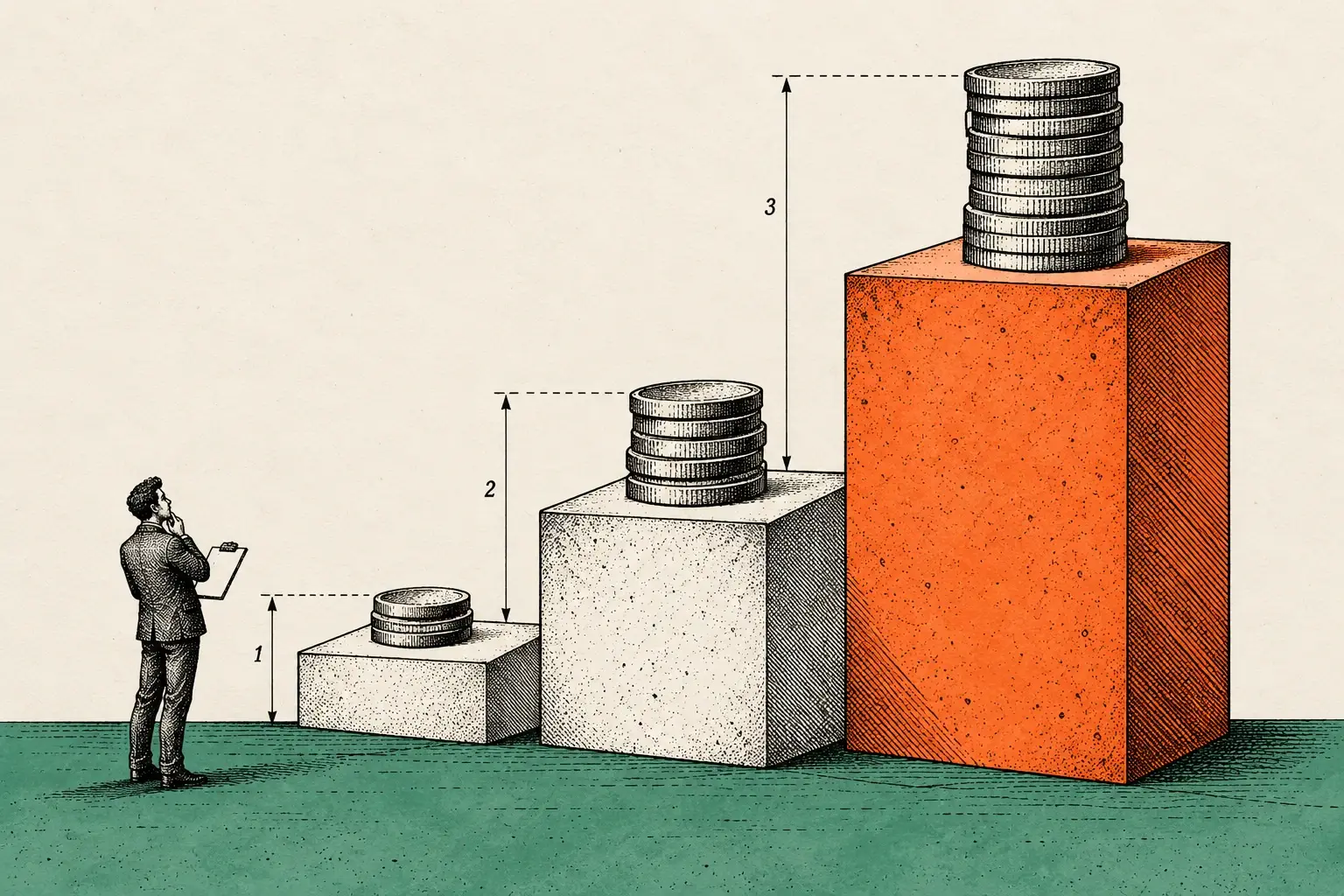
US utility patents stay in force only if the owner pays patent maintenance fees at 3.5, 7.5 and 11.5 years after grant. For a large entity the three payments now total $14,470, and each one costs about twice the last. Treat every due date as a decision point (keep, sell, license or lapse) and make that decision with data, not by default.
The current fee table
These are the fees on the USPTO fee schedule under the rule effective January 19, 2025.
| Fee | Window opens (no surcharge) | Due | Grace period ends | Large | Small | Micro |
|---|---|---|---|---|---|---|
| First | 3 years after grant | 3.5 years | 4 years | $2,150 | $860 | $430 |
| Second | 7 years | 7.5 years | 8 years | $4,040 | $1,616 | $808 |
| Third | 11 years | 11.5 years | 12 years | $8,280 | $3,312 | $1,656 |
| Grace-period surcharge | — | — | — | $540 | $216 | $108 |
The timing comes from 37 CFR 1.362. You can pay without a surcharge in the six months before each due date. You can pay with the surcharge in the six months after it. If neither payment arrives, the patent expires at the end of the grace period, on the 4th, 8th or 12th anniversary of grant. Design and plant patents pay no maintenance fees.
USPTO large-entity maintenance fees by window
USD
What the full life of a patent costs
Keeping one large-entity patent to full term costs $14,470 in maintenance fees. A small entity pays $5,788, and a micro entity $2,894. Those totals cover USPTO fees only, not annuities on foreign family members or the cost of tracking deadlines.
The more useful number is the cost per year of protection. A utility patent’s term generally ends 20 years after its earliest US nonprovisional filing date, under 35 U.S.C. § 154, subject to any patent term adjustment. Take an illustrative patent granted three years after filing, with no adjustment. It expires about 17 years after grant.
| Payment | Keeps the patent in force | Years bought | Large-entity cost per year |
|---|---|---|---|
| First ($2,150) | Years 4–8 after grant | 4 | about $538 |
| Second ($4,040) | Years 8–12 | 4 | about $1,010 |
| Third ($8,280) | Year 12 to expiry | about 5 | about $1,656 |
The price of a protected year roughly triples. Longer pendency makes it worse: if grant took five years, the third fee buys about three years at about $2,760 each. The final payment is the one most worth questioning.
Budget by window, not by patent
Portfolios feel this in bulk. Group patents by the window they reach each year and multiply. Here is a hypothetical large-entity portfolio with 60 patents due in one year:
| Window | Patents due | Fee each | Subtotal | Share of spend |
|---|---|---|---|---|
| 3.5 years | 25 | $2,150 | $53,750 | 21% |
| 7.5 years | 20 | $4,040 | $80,800 | 31% |
| 11.5 years | 15 | $8,280 | $124,200 | 48% |
| Total | 60 | — | $258,750 | 100% |
The oldest quarter of the portfolio takes almost half the budget. That is where a review pays for itself first. It is also where patents are most likely to be tied to older product lines.
How many patents are kept to full term
In a March 2026 analysis of USPTO maintenance records, Patently-O’s Dennis Crouch put the share of patentees paying all three fees at about 40%. That is down from a peak of roughly 52% around 2012–2013 and near the lowest level in two decades. He notes that these are self-selected patents, so the trend may reflect more than fee levels.
Expired patents are also public data. The Official Gazette, published each Tuesday, carries notices of patents that expired for failure to pay a maintenance fee and of patents reinstated after late payment. Your competitors can see your lapses, and you can see theirs.
A data-led keep, sell, license or lapse decision
The fee is known. The value is the uncertain part, so collect evidence for each patent before the window opens.
| Signal | Points to keep | Points to sell or license | Points to lapse |
|---|---|---|---|
| Use in your own products or roadmap | Core to current or planned products | Product line exited or divested | No link to any product |
| Technical evidence of use by others | Supports your market position | Clear use by companies that might buy or license | None found after a real search |
| Forward citations | Cited against competitors’ filings | Cited by many outside assignees | Few or none |
| Remaining term | Long | Long enough for a buyer’s plans | Short, with the last fee due |
| Family coverage | Covers your key markets | Covers the buyer’s key markets | Single country, minor market |
| Inbound interest | Licensing revenue or cross-license use | Unsolicited inquiries | None |
Then work through the steps.
- Build the calendar early. List every patent with its window-open date, due date and grace-period end. Start reviews about six months before each window opens.
- Gather the facts per patent. That means status, family, assignment record, citations, and a technical map of claims against products. Our investor due-diligence checklist covers the same fields.
- Tier the portfolio. Sort patents into keep, market, and lapse candidates. Write down why for each one, so the next review starts from evidence instead of memory.
- Market the “sell” tier before the fee is due. A sale campaign commonly runs for months. See how to sell a patent for a realistic timeline.
- Confirm entity status. The small and micro discounts depend on legal criteria, and ownership changes can affect them. Your patent practitioner should confirm status before you pay a reduced fee.
- Treat lapse as final. Under 37 CFR 1.378, the USPTO can accept payment after expiration only on a petition stating the delay was unintentional. On the current schedule, the large-entity petition fee is $2,260 for delays of up to one year and $3,000 beyond that. Because the petition turns on the delay being unintentional, treat a deliberate lapse as final and talk to your attorney or agent before you choose it.
A quick test for the third fee
Ask three questions. Would we assert, license or sell this patent in the next five years? Does anyone outside the company use what it claims? Would a competitor change course if it lapsed? If all three answers are no, the $8,280 is probably better spent elsewhere. If any answer is yes, document it and pay on time.
There is a fourth possibility: someone else uses the technology, but you don’t. Then the patent may be worth more to a buyer or licensee than to you. A buyer will price in the fees still to come, so market it while the next window is still some way off.
Mistakes that cost more than the fee
- Paying by default because a renewal reminder arrived before anyone asked whether the patent still matters.
- Deciding one patent at a time without looking at its family, so one member lapses while a related application is still pending.
- Starting a sale too late, so the patent you meant to sell lapses mid-campaign or sells at a discount.
- Paying at a reduced rate after an acquisition or license changed your entity status.
- Keeping no record of why each patent was kept or dropped, so every review starts from zero.
This article is general information, not legal advice. Fee decisions and entity status should be confirmed with your patent attorney or agent.
How Meta Dragons can help
Each window costs more than the last, so decide on purpose. Our Portfolio Pruning Analytics ranks keep, sell, license and lapse candidates in 2–4 weeks. It weighs upcoming fees against citation, product-mapping and market signals, and every ranking comes with its assumptions written down. Portfolio Administration tracks public status and fee windows in Hoard Ledger, for administrative purposes, and coordinates with your registered practitioner. To estimate your own exposure, try the maintenance fee calculator.
Sources
- USPTO fee schedule — USPTO
- Patent fee changes to take effect on January 19 — USPTO
- 37 CFR § 1.362 — Time for payment of maintenance fees — Cornell Law School LII
- 37 CFR § 1.378 — Acceptance of delayed payment of maintenance fee in expired patent — Cornell Law School LII
- 35 U.S.C. § 154 — Contents and term of patent — Cornell Law School LII
- Are Rising Maintenance Fees Shortening the Effective Patent Term? — Patently-O
- Official Gazette for Patents, September 29, 2026 — USPTO
This article is general information about patent research and the patent market. It is not legal, financial or investment advice. Meta Dragons is not a law firm; for legal questions, consult a registered patent attorney or agent.