§Engagement profile · Illustrative composite
An SBIR patent landscape for a Phase II commercialization plan
An illustrative composite: a battery thermal-management startup preparing an SBIR Phase II proposal. We mapped the field, framed whitespace hypotheses, and built 3D visuals that reviewers could read at a glance.
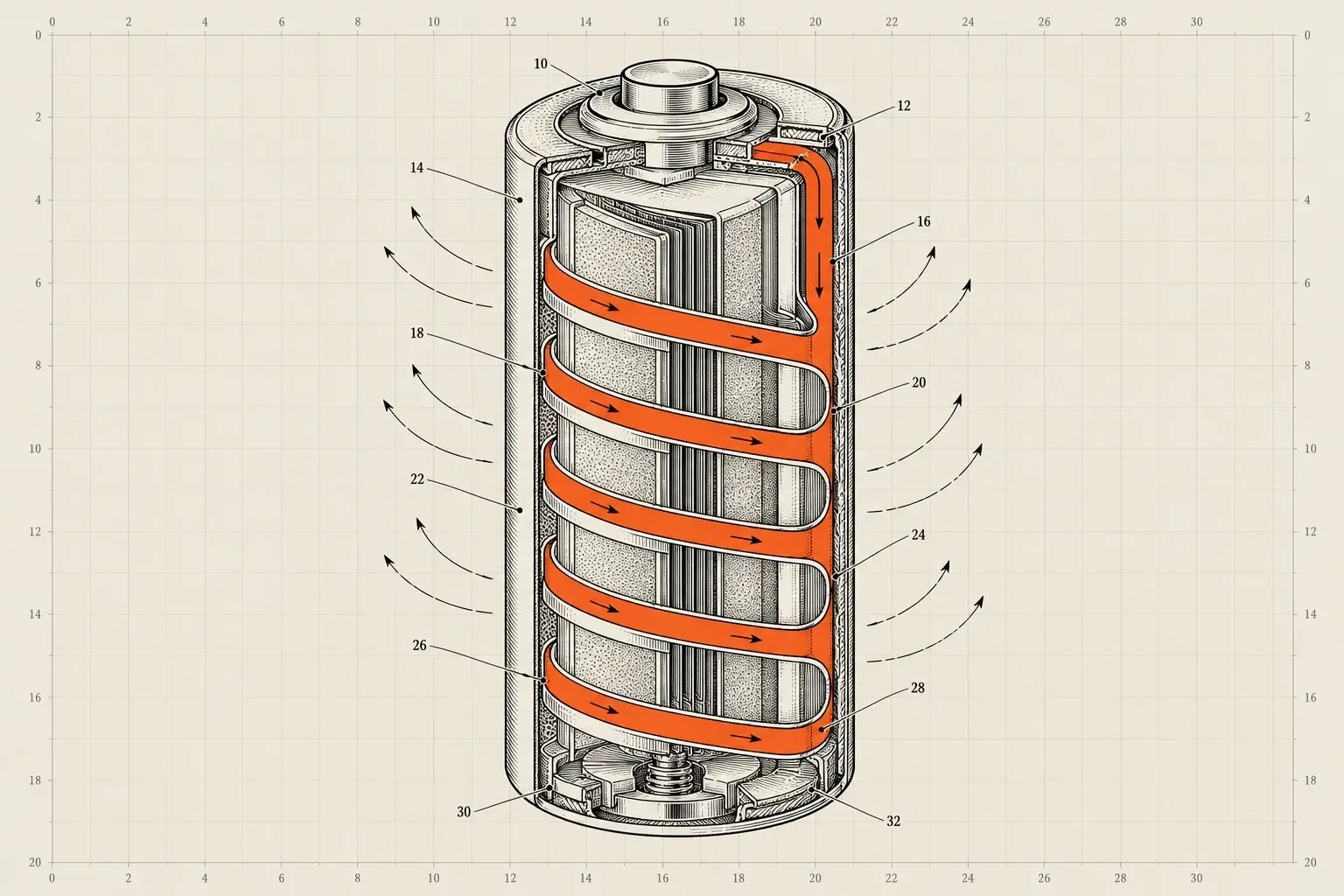
Illustrative composite. This profile is drawn from patterns across typical engagements. Names, figures and details are changed, and it does not depict any real client, person or institution.
- Segment
- Early-stage hardware startup, battery thermal management
- Services used
- Patent Landscape & Whitespace, 3D Visualization & Animation, Hoard Atlas and Watch
- Duration
- 5 weeks for the landscape, with visuals in parallel; Watch ongoing
- Composite note
- Illustrative composite drawn from typical engagements. Details are changed, and no real client is depicted.
§ 01Context
The situation
This SBIR patent landscape profile is an illustrative composite, drawn from typical engagements with details changed. No real client is depicted.
A nine-person startup had finished an SBIR Phase I project on thermal management for lithium-ion battery modules. Their design sleeves each cylindrical cell in a phase-change composite, paraffin in a graphite matrix, that soaks up heat spikes. A thin aluminum cold plate with serpentine microchannels carries the stored heat away between spikes. The target was electric off-highway equipment: loaders, mining shuttles, and airport tugs that run hard in hot places.
Phase II needed a commercialization plan. The SBA’s SBIR/STTR Policy Directive lists intellectual property among its elements: patent status, technology lead, and how the company will protect a competitive advantage.
The team had one provisional application, filed by their patent attorney, and an instinct that nobody did it quite like this. Reviewers would want more than instinct. The founders also wondered whether to chase passenger EVs instead. The deadline was 8 weeks away.
§ 02Context
What we did
The patent landscape had to answer three questions in time. Who is active in battery thermal management? How crowded is the pairing of a phase-change layer with liquid cooling? And where is the field thin?
The landscape. We searched by classification and by meaning together. Classification started from CPC group H01M 10/60 (temperature control of secondary batteries), including its subgroups for vehicles and for heat storage by phase change. On the semantic side, the team’s own technical description seeded AI-assisted similarity searches, which caught the same idea in other words, such as “latent heat buffer.” Citation expansion filled the gaps. Analysts coded each relevant family by cooling approach, cell format, application, and assignee.
The results went into Hoard Atlas: filing trends, assignee skylines, and class overlap. Two patterns stood out. Phase-change-plus-liquid designs existed, but mostly for pouch and prismatic car cells, held by a few large suppliers. Off-highway equipment appeared mostly in passing, rarely as the focus of the claims.
Whitespace hypotheses. We framed three, each labeled a hypothesis rather than a finding, with the references that defined its edges:
- Cylindrical-cell packs pairing phase-change layers with microchannel cold plates for off-highway duty cycles drew comparatively few families.
- Replacing the thermal layer without scrapping the module was rarely the subject of claims.
- Sensors in the phase-change layer that estimate remaining capacity appeared mostly in academic papers, not patents.
We also said what whitespace can mean: open ground, or a market nobody wants. And the team’s own provisional, still unpublished, was invisible to the landscape, like everyone’s filings from roughly the last 18 months.
The visuals. In parallel, our illustrators built a 3D exploded view of the module and a 20-second animation of heat moving from a cell into its sleeve and out through the channels.
§ 03By the numbers
Illustrative composite figures
Composites, rounded and changed, not a real result.
Patent families surfaced by the search
Source: Composite figure
Relevant families read and coded by analysts
Source: Composite figure
Assignees profiled in the Atlas skyline
Source: Composite figure
Whitespace hypotheses, each with defining references
Source: Composite figure
From kickoff to landscape delivery
Source: Composite figure
§ 04Context
What changed
The commercialization plan’s IP section went from a sentence of hope to a page of evidence: who files most, which combinations are crowded, and where the company’s approach sits. One Atlas chart and the exploded view made the point for reviewers who weren’t thermal engineers.
The bigger change was strategic. Passenger-car thermal management was crowded with large, well-funded filers, so the founders narrowed the plan to off-highway equipment, where their test data was strongest and filings were thinner.
Their patent attorney used the reference spreadsheet and the hypotheses while preparing the nonprovisional application, filed before the provisional’s 12-month deadline. What it claims was the attorney’s work and the founders’ decision; we didn’t draft it or advise on it.
The proposal went in on time, and funding is the agency’s call. The team kept a Hoard Watch feed on the 12 most active assignees, with a monthly analyst digest, and later opened its Atlas workspace to an investor during due diligence.
Showing where the field already stands is what makes your step forward legible.
A reviewer can’t judge a leap without seeing the ground it leaves from.
Keep reading
Related pages
§Next step
Writing a Phase II proposal?
Tell us your deadline on a free scoping call. We’ll quote a landscape sized to it within one business day.