§Engagement profile · Illustrative composite
University patent licensing for a dormant photonics portfolio
An illustrative composite: a technology-transfer office with photonics families nobody had marketed in years. We sorted what to keep, found licensees in five industries, and made documented introductions. University counsel handled every agreement.
Illustrative composite. This profile is drawn from patterns across typical engagements. Names, figures and details are changed, and it does not depict any real client, person or institution.
- Segment
- University technology-transfer office, photonics and optical sensing
- Services used
- Portfolio Pruning Analytics, Licensee Identification, 3D visuals, Hoard Ledger
- Duration
- 3 weeks of pruning analysis, 5 weeks of licensee research, then 6 months of introductions
- Composite note
- Illustrative composite drawn from typical engagements. Details are changed, and no real client, person, or institution is depicted.
§ 01Context
The situation
This university patent licensing profile is an illustrative composite, drawn from typical engagements with details changed. No real client, person, or institution is depicted.
A public research university’s technology-transfer office held 34 patent families from its photonics program. Fourteen had no license, no option, and no active conversation. Some were older than the tenure of the staff now responsible for them.
Two licensing associates covered the whole university, and photonics was one of a dozen fields on their desks. The fees kept coming: US maintenance fees, plus annuities on European and Asian counterparts filed when someone expected a big licensee. The director’s question was blunt. Which of these should we keep paying for, and who would want the rest?
The dormant families included a femtosecond-laser method for writing fiber Bragg gratings, a distributed fiber-optic strain-sensing scheme, a metasurface lens for compact infrared imaging, and a low-loss silicon-nitride waveguide process.
§ 02Context
What we did
Pruning first. Marketing all 14 families would have spread the office even thinner, so we started with Portfolio Pruning Analytics. Each family’s public record went into Hoard Ledger: status, remaining term, foreign coverage, and the next fee windows. We added market signals, such as forward citations from companies and product activity in the field, and ranked each family as a keep, market, or lapse candidate with a one-line reason.
The office made every call, with input from the inventors and university counsel. Four families became lapse candidates, and under the university’s own policy the inventors were offered two of them first. Two more stayed for reasons tied to an active research grant. That left eight to market.
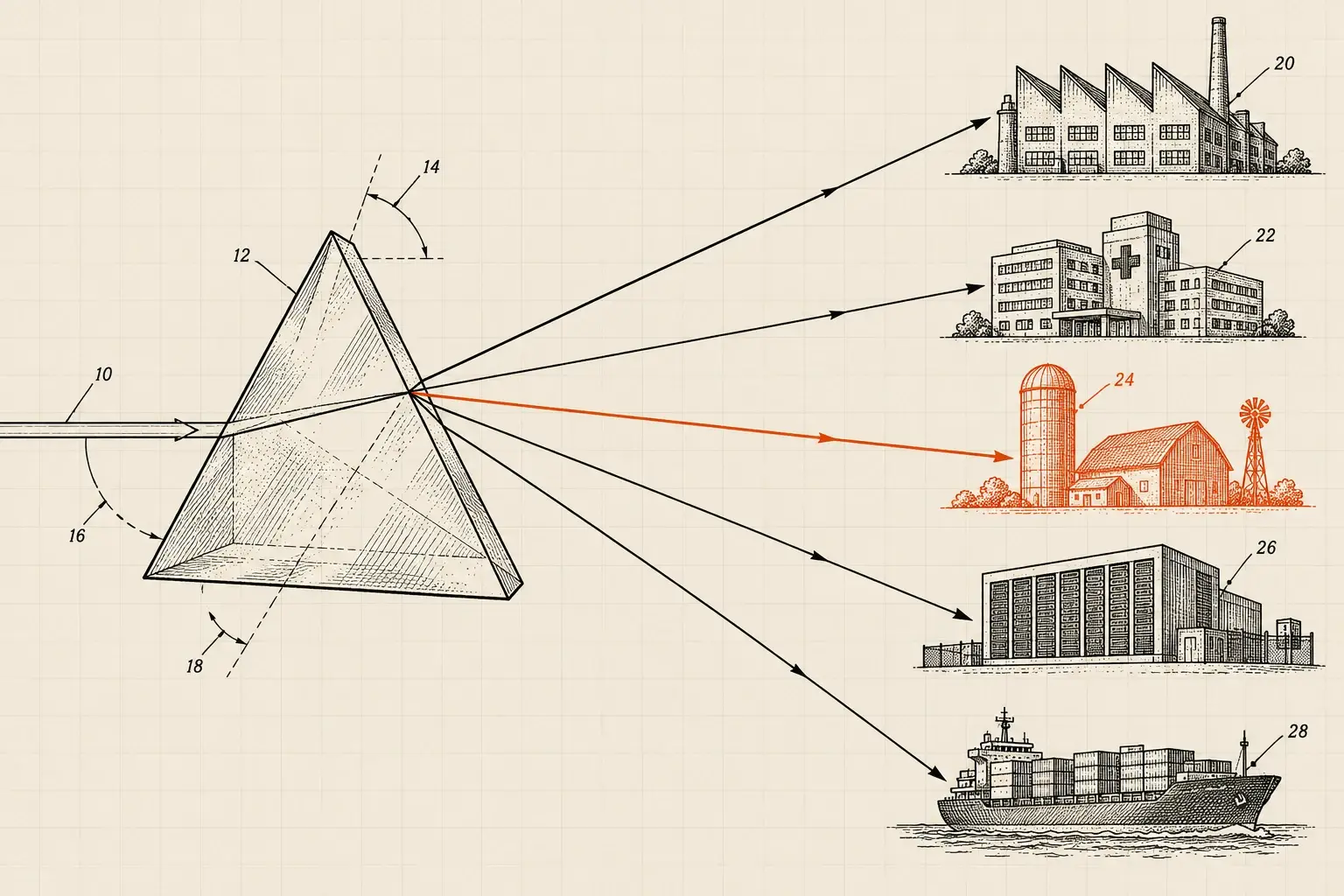
One family, many industries. The strain-sensing family showed why licensee research has to cross industries. The same method reads strain along an optical fiber. A wind-turbine maker sees blade monitoring. A pipeline operator sees leak detection. A catheter company sees shape sensing inside the body. An aerospace supplier sees structural health monitoring, and a civil engineer sees bridges. Each audience needs a different first paragraph.
For each of the eight families, our Licensee Identification team built a target list from product-to-patent research: who sells in the field, who files nearby, who cites the university’s patents, and who has licensed university technology before. Each company came with the evidence for its place on the list. We wrote a two-page non-confidential packet per family, reviewed by the office and inventors, with a rendered view where a picture explained more than a paragraph.
Introductions, documented. We contacted R&D and business-development leads in the university’s name and with its approval, and logged every touch. When a company wanted to talk, we set up a call with the office and the inventor. From there the university took over: its counsel negotiated and drafted every agreement. We didn’t draft, review, or negotiate any of them.
§ 03By the numbers
Illustrative composite figures
Composites, rounded and changed, not a real result.
Dormant families reviewed and ranked
Source: Composite figure
Industries mapped for the strain-sensing family alone
Source: Composite figure
Companies screened, with 24 sent a marketing packet
Source: Composite figure
Introductory calls held within 6 months
Source: Composite figure
Agreements, all negotiated by university counsel
Source: Composite figure
§ 04Context
What changed
Within 6 months, eight companies had taken introductory calls and four had asked for confidential follow-up under the university’s NDA. Three agreements followed, all negotiated and signed by the university: an exclusive option on the metasurface lens family for an infrared-camera startup, and two non-exclusive field-of-use licenses on the strain-sensing family, one in wind energy and one in pipeline monitoring. The medical field stayed open on purpose, so a catheter company could still take an exclusive license there.
Dropping four families and their foreign counterparts cut projected renewal spend over 5 years by roughly a fifth, and that money went to the families that were moving.
Not every family found a home. Three drew polite interest and nothing more, but the office now knows who looked and why they passed, which matters the next time a fee window opens.
The office kept its Ledger workspace and asked for a yearly pruning review timed to its budget cycle. See how we support universities and labs.
One family, many spectra: the same invention lands differently in every industry it reaches.
Licensee research is the work of finding where it lands best.
Keep reading
Related pages
§Next step
Sitting on dormant families?
Tell us how many families and which fields. We’ll send a fixed-fee quote within one business day of a free scoping call.